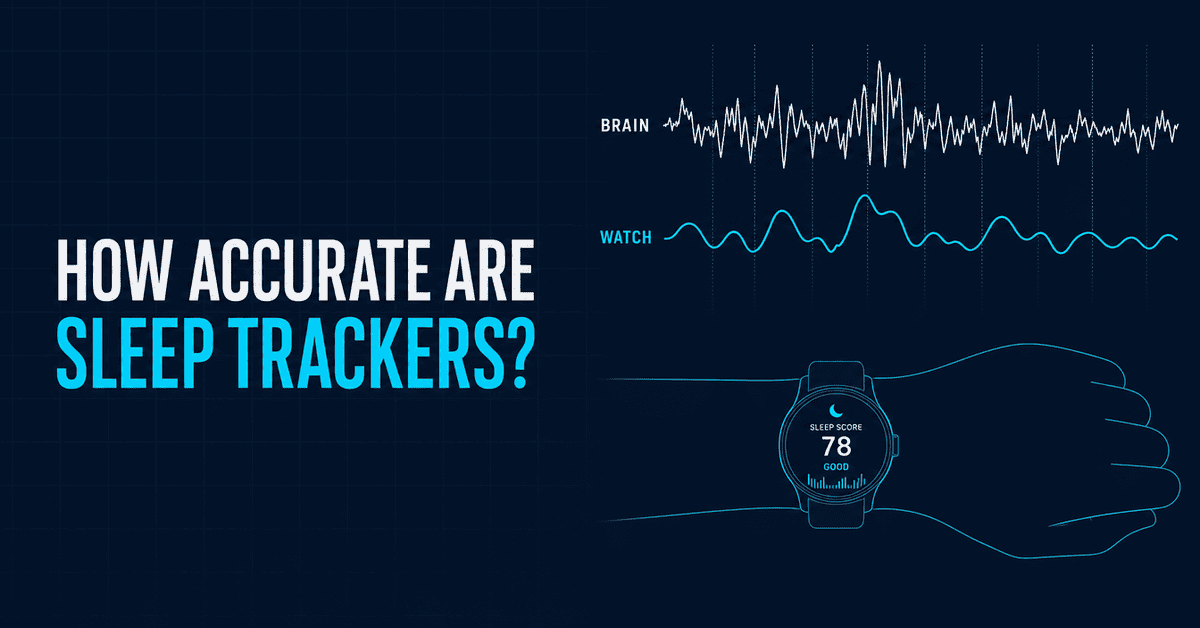
You wore it all night. It says you got 1 hour and 43 minutes of deep sleep. But how accurate are sleep trackers, actually — and should you trust that number enough to change your routine over it? The honest answer: your watch can’t see your brain, which means every stage number it shows you is an educated guess. Some of those guesses are excellent. Some are barely better than a coin flip. We broke down how the guessing works in the video below — this article adds the validation data and a practical trust hierarchy for every metric on your morning report.
How sleep trackers actually measure sleep
Sleep stages are defined by brain activity. In a sleep lab, polysomnography (PSG) reads your EEG — electrodes on your scalp watching the slow waves of deep sleep and the near-waking activity of REM directly. That’s the ground truth.
Your wearable has no access to any of that. Instead, it watches proxies from your wrist or finger:
- Movement (accelerometer) — the oldest signal: still body suggests sleep, movement suggests wake or light sleep.
- Heart rate — drops in deep sleep, becomes variable and elevated in REM.
- Heart rate variability (HRV) — parasympathetic dominance in deep sleep produces a distinct HRV signature.
- Skin temperature and respiratory rate — both follow stage-dependent patterns.
An algorithm — trained on thousands of nights where people wore the device and PSG simultaneously — pattern-matches your proxy signals to the most likely stage. When your physiology behaves like the training data, the guess is good. When it doesn’t (and everyone’s autonomic patterns are a little idiosyncratic), the guess drifts. That’s not a flaw to fix; it’s the physics of measuring a brain from a wrist.
How accurate are sleep trackers? What validation studies show
Dozens of studies have compared consumer wearables against PSG. The results are remarkably consistent — and they split cleanly by metric:
| Metric | Typical agreement with lab measurement | Verdict |
|---|---|---|
| Asleep vs. awake | ~90%+ | Trust it |
| Total sleep time | Good — usually within ~20–30 minutes | Trust the trend, forgive the minutes |
| Sleep efficiency | Good | Trust the trend |
| Sleep stages (deep / REM / light) | ~60–80% epoch agreement | Directional at best — never judge a single night |
| Sleep latency | Weak — quiet wakefulness looks like sleep | Lowest confidence metric |
Two failure modes are worth knowing because you’ll see them in your own data. First, trackers can’t see quiet wakefulness: lie perfectly still reading or meditating and most devices will score it as light sleep — which inflates your total and flatters your latency. Second, stage transitions get smoothed: brief awakenings and rapid stage shifts are exactly where wrist algorithms disagree most with the EEG.
The trust hierarchy: how to read your morning report
Instead of asking “is my tracker accurate?”, rank each number by how much confidence it deserves:
- Bedtime and wake time — nearly perfect. Use them freely.
- Total sleep duration — solid. The single most actionable number on the report.
- Overnight heart rate and HRV — these are measured, not guessed, and finger/wrist optical sensors read them well at rest. Trend them against your baseline — our HRV & Sleep Connection guide shows how.
- Sleep efficiency and wake episodes — good for spotting fragmentation patterns, like the ones behind 3 a.m. waking.
- Stage minutes (deep/REM) — directional only. “My deep sleep trend fell 20% over two weeks” is signal; “I got 47 minutes last night” is noise with an invisible error bar.
- Latency — treat as a rough sketch.
Notice what this means for the composite number on top of the report: it inherits the weaknesses of its worst ingredients. That’s a big part of why your sleep score deserves trend-level trust, not verdict-level trust.
Does accuracy even matter for what you’re using it for?
Here’s the reframe that resolves most of the accuracy anxiety: a tracker doesn’t need lab precision to be useful — it needs consistency. Your device is imprecise in roughly the same way every night. That makes it a poor absolute instrument but a genuinely good within-person comparison instrument. If the same algorithm, on the same wrist, says deep sleep rose for two weeks after you cooled the bedroom — that comparison is meaningful, even if the absolute minutes are off.
Practically:
- Run experiments, not audits. Two-week baseline, one change, two-week comparison. (Caffeine cutoff, temperature, alcohol, magnesium — one lever at a time.)
- Compare you to you. Never your stage minutes to a friend’s on a different brand — the algorithms aren’t measuring the same thing.
- Anchor to feel. Rate your energy each morning before looking at the app. If device and feeling repeatedly disagree, trust the two-week trend of both over any single morning.
- Take the one metric seriously that’s genuinely medical: repeated overnight SpO2 dips are worth clinical attention — our SpO2 & Sleep Apnea Signals guide covers which patterns warrant a sleep study.
The bottom line
How accurate are sleep trackers? Excellent at knowing when you’re asleep, good at duration and overnight physiology, mediocre at stages, weak at latency — because stages live in your brain and your watch is reading your wrist. Use the trust hierarchy: act confidently on duration, heart rate, and HRV trends; treat stage minutes as direction, not truth; and remember the tracker’s real superpower is comparing this week’s you to last week’s you. For the full method, start with the Sleep Score Interpretation protocol, and if you’re choosing a device, our wearable reviews compare the options honestly.
Frequently asked questions
Are sleep trackers accurate for deep sleep?
It’s their weakest area. Validation studies put stage-level agreement with lab EEG at roughly 60–80%, and single-night deep sleep minutes can be off meaningfully in either direction. Track the two-week trend of your deep sleep, not the nightly value — direction is reliable even when the minutes aren’t.
Which sleep tracker is the most accurate?
No consumer device reads brain waves, so none measures true sleep stages. Ring-style devices tend to do well overnight because finger-based optical heart-rate data is strong at rest, but every major brand is good at sleep/wake detection and only moderate at staging. Choose on comfort, battery, and ecosystem — then judge trends.
Can a sleep tracker diagnose sleep apnea?
No. Some devices flag suggestive patterns — repeated blood-oxygen dips, breathing disturbances — and those flags are worth taking seriously as a reason to see a doctor. But diagnosis requires a clinical sleep study. Treat the tracker as a smoke detector, not a fire marshal.
Why does my tracker say I slept when I was awake?
Because you were still. Trackers infer wakefulness largely from movement and heart-rate shifts, so lying motionless — reading, meditating, or quietly failing to fall asleep — often gets scored as light sleep. This is why latency and brief-wake counts are the least trustworthy numbers on your report.