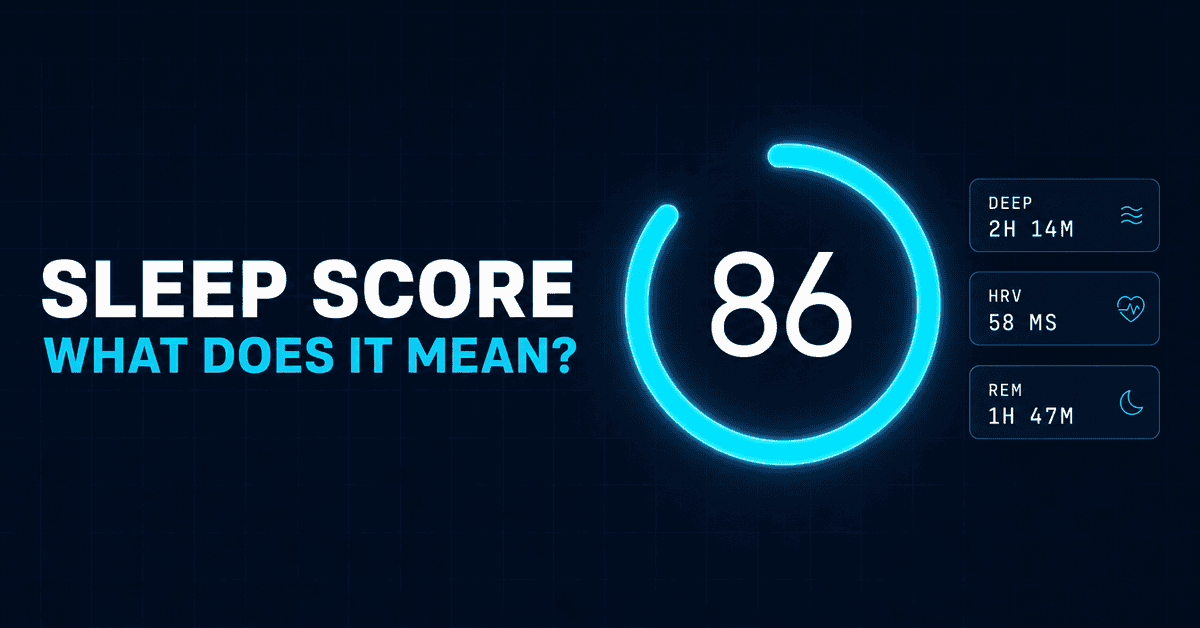
Your ring says 86. Your friend’s wrist strap says 71. You both feel exactly the same this morning. So what does sleep score mean, really — and should a single number be deciding how you feel about your night? Short answer: a sleep score is a genuinely useful trend instrument and a genuinely misleading daily verdict. We put the biggest sleep-score myths under the microscope in the video below; the article goes deeper on how the number is built, how each major wearable calculates it differently, where the accuracy limits are, and how to actually use it to sleep better.
What does a sleep score mean? The ingredients inside the number
Every wearable brand blends roughly the same ingredients — they just weight them differently. Under the hood of almost every sleep score you’ll find:
- Total sleep duration — how much you slept versus your (or the population’s) need. Usually the heaviest-weighted input.
- Sleep efficiency — the percentage of time in bed you actually spent asleep. Above ~85% is generally considered good.
- Sleep latency — how long you took to fall asleep. Both too long (can’t switch off) and suspiciously short (overtired) can cost points.
- Deep sleep and REM minutes — the restorative stages. Deep sleep dominates the first half of your night, REM the second, which is why a short night disproportionately cuts REM.
- Restlessness and wake episodes — how fragmented the night was.
- Physiological recovery signals — overnight resting heart rate, heart rate variability (HRV), and sometimes skin temperature and respiratory rate versus your baseline.
- Timing and consistency — whether you slept in your usual window. Irregular schedules quietly drain scores even when duration looks fine.
Two of those ingredients — HRV and resting heart rate — do the heavy lifting in “readiness”-type scores, and they’re worth understanding on their own. Our HRV & Sleep Connection guide covers what actually moves them.
Same night, different number: how the major brands score sleep
| Device | What the score emphasises | Quirk worth knowing |
|---|---|---|
| Oura Ring | Duration, efficiency, restfulness, timing — plus a separate “Readiness” score for recovery | Weights consistency heavily: the same 7 hours scores worse at an unusual time |
| Whoop | “Sleep Performance” — hours slept versus hours your strain says you needed | It’s a debt calculation, not a quality grade; a calm 7-hour night can score low after a heavy training day |
| Garmin | Duration, stages, restlessness, plus stress/Body Battery integration | Its overnight stress metric (HRV-based) can tank a score even when stages look fine |
| Apple Watch | Stages and duration versus your sleep goal — no single native “score” | Third-party apps fill the scoring gap, each with its own formula |
This is why comparing your 86 to a friend’s 71 across brands is meaningless. The scores aren’t measuring the same thing — one grades last night’s architecture, another grades your sleep debt, a third grades your nervous system’s recovery. Cross-brand score envy is the emptiest game in wearables. If you’re choosing a device, compare them on what they measure best — our wearable reviews break that down.
How accurate is your sleep score?
Honest answer: good enough to be useful, not good enough to be gospel. Consumer wearables estimate sleep stages from movement, heart rate, HRV, and temperature — they cannot see brain waves, which is how sleep stages are actually defined in a lab (polysomnography). Validation studies consistently show the same pattern:
- Detecting sleep vs. wake: very good — typically 90%+ agreement with lab measurement.
- Total sleep time and efficiency: good, usually within a modest margin of error.
- Stage-by-stage accuracy (deep vs. REM vs. light): the weak spot — agreement with lab scoring commonly lands around 60–80%, and single-night stage minutes can be off meaningfully.
The practical implication is simple: trust direction, not decimals. “My deep sleep trend is down 20% over two weeks” is a signal worth acting on. “I only got 47 minutes of deep sleep last night” is a number with an error bar you can’t see. We go deeper on reading each metric in the Sleep Score Interpretation protocol.
The score trap: when tracking backfires
One caveat the industry doesn’t advertise: for a subset of people, chasing a sleep score becomes its own sleep problem. Sleep researchers coined a term for it — orthosomnia — where anxiety about achieving perfect sleep data measurably worsens sleep. The tells: you feel fine until you see a bad score and then feel tired; you lie in bed doing score math; a bad readiness number ruins your morning before it starts.
The score is a coach, not a judge. The moment the number starts dictating how you feel rather than describing how you slept, it’s working against you — turn the morning report off for two weeks and judge your days by your days.
How to actually use your sleep score
Used correctly, a sleep score is one of the best behaviour-change tools ever put on a wrist. The method:
- Establish a two-week baseline. No changes, just data. Note your average score, deep sleep, HRV, and wake episodes.
- Change one variable at a time. Caffeine cutoff, bedroom temperature, alcohol, magnesium, wind-down routine — one lever per two-week block. (Two of the highest-leverage experiments: the magnesium protocol we covered in Is 500 mg of Magnesium Too Much?, and fixing the middle-of-the-night waking pattern from Wake Up at 3 A.M.?)
- Judge the trend against the baseline. A real improvement shows up as a shifted two-week average, not one great night.
- Calibrate against how you feel. Rate your energy 1–10 each morning before looking at the score. Over a month you’ll learn how well your device’s number maps to your reality — that calibration is what makes the score trustworthy.
- Let the subscores tell you which protocol to run. Low efficiency with long wake episodes points at arousal and environment; short REM points at duration and alcohol; sagging HRV points at stress, training load, and late meals.
The bottom line
A sleep score is a composite estimate — duration, efficiency, stages, fragmentation, and recovery signals blended into one number by a formula that differs across brands. It measures sleep-wake patterns well, sleep stages roughly, and your subjective experience not at all. Use it as a two-week trend instrument, pair it with one experiment at a time, and never let a single morning’s number tell you how to feel. That’s the entire game.
Want the full framework for turning wearable data into better nights? Start with the Sleep Score Interpretation protocol, then browse the complete protocol library.
Frequently asked questions
What is a good sleep score?
On most platforms, 85+ is considered excellent and 70–84 good — but the more useful benchmark is your own two-week average. A “good” score is one meaningfully above your personal baseline, achieved at your normal bedtime, on a night you also felt rested.
Why is my sleep score low even though I feel fine?
Usually one of three reasons: the algorithm penalised timing or consistency rather than quality; a stage-estimation error undercounted deep sleep or REM; or a recovery input like HRV dipped for reasons unrelated to sleep (late meal, alcohol, hard training). Feeling genuinely good is data too — when score and feeling disagree repeatedly, trust the two-week trend of both.
Which wearable has the most accurate sleep score?
No consumer device measures true sleep stages — all estimate from movement, heart rate, and temperature. Ring-style devices tend to perform well for sleep specifically because finger-based heart-rate data is strong overnight, but the honest answer is that all major brands are good at sleep/wake detection and only moderate at staging. Pick based on form factor and ecosystem, then judge trends, not absolute numbers.
Should I try to increase my deep sleep score?
Indirectly, yes. You can’t target a stage directly, but deep sleep responds to the fundamentals: a cool bedroom, no late alcohol, an early caffeine cutoff, consistent timing, and managed evening stress. Improve those and the stage minutes — and the score — follow.