You grab two magnesium capsules before bed — 250 mg each. That’s 500 mg. Perfectly normal, right? It depends. If you’ve been wondering is 500 mg of magnesium too much, the honest answer is: it exceeds the official safety threshold for supplements, it’s more than the research says you need for sleep, and — depending on which form is in that bottle — it might be doing more for your bathroom schedule than your deep sleep. Here’s what the science actually says.
The official number: what the NIH says about magnesium dosage
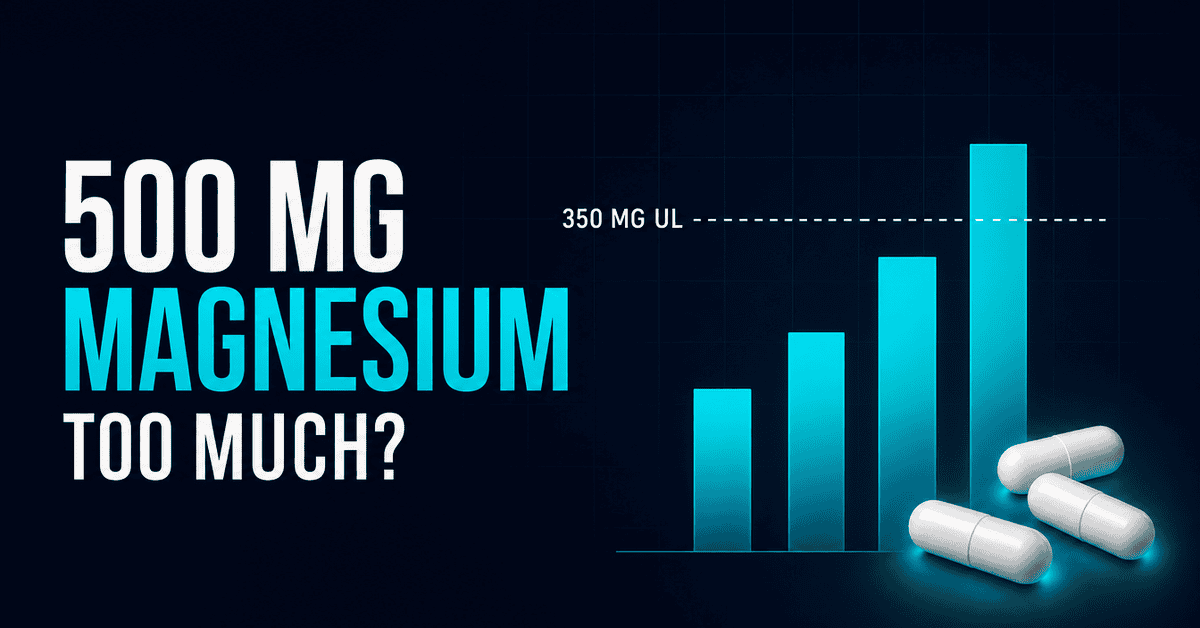
The National Institutes of Health sets a Tolerable Upper Intake Level (UL) of 350 mg per day for supplemental magnesium in adults. Two things about that number matter more than the number itself:
- It only counts supplements. Magnesium from food — spinach, almonds, black beans, dark chocolate — doesn’t count toward the UL, because your gut regulates absorption from food far more effectively.
- It’s a GI-comfort threshold, not a toxicity line. The UL is set at the point where diarrhea and cramping become likely in sensitive people. True magnesium toxicity is rare in people with healthy kidneys and generally requires massive doses.
So 500 mg from supplements puts you 150 mg over the UL. That’s not dangerous for most healthy adults — but it does raise your odds of the classic high-dose side effects: loose stools, cramping, and nausea. And for sleep specifically, there’s a better question than “is it safe?” — it’s “is it even useful?”
The form matters more than the dose
Here’s the part most supplement labels quietly bury: “500 mg of magnesium” almost never means 500 mg of actual magnesium. The mineral is bound to a carrier molecule, and both the elemental magnesium content and the absorption rate vary wildly between forms.
A typical “400 mg magnesium glycinate” capsule contains only around 58 mg of elemental magnesium — the rest of the weight is the glycine molecule it’s bound to. Meanwhile, magnesium oxide packs a lot of elemental magnesium by weight but absorbs at roughly 4% — at high doses it’s effectively a laxative with a health halo.
| Form | Bioavailability | GI Tolerance | Best For | Risk at 500 mg |
|---|---|---|---|---|
| Magnesium Glycinate | High | Very gentle | Sleep, anxiety, recovery | Low |
| Magnesium Threonate | High (brain) | Gentle | Cognitive sleep quality | Low |
| Magnesium Malate | High | Gentle | Energy, muscle recovery | Moderate |
| Magnesium Citrate | Moderate | Moderate | Constipation, general use | Moderate |
| Magnesium Oxide | Very low (~4%) | Poor | Antacid use | High |
| Magnesium Sulfate | Low (oral) | Poor | Epsom salts / IV use | Very high |
The practical takeaway: 500 mg of magnesium oxide and 500 mg of magnesium glycinate are completely different experiences. The first delivers maybe 20 mg of usable magnesium plus a solid chance of GI disruption at 2 a.m. The second is gentle, well-absorbed, and — as we’ll see — probably more than you need anyway. For sleep, glycinate is the default choice; threonate is the specialist option if your goal is cognitive sleep quality, since it’s designed to cross the blood–brain barrier.
How magnesium actually improves sleep
Magnesium isn’t a sedative. It supports sleep through three well-documented mechanisms:
- GABA receptor activation. Magnesium supports GABA, your brain’s primary inhibitory neurotransmitter — the “off switch” signalling that lets your nervous system downshift.
- NMDA receptor blocking. Magnesium sits in the NMDA receptor channel and dampens excitatory signalling. Low magnesium leaves this pathway overactive — one reason deficiency is associated with the racing-mind, can’t-switch-off feeling at bedtime.
- Melatonin synthesis. Magnesium is an enzymatic cofactor in the pathway your body uses to manufacture melatonin from serotonin. Deficiency can bottleneck your natural melatonin production.
Notice what all three mechanisms have in common: they’re about restoring normal function when magnesium is low. That’s why the research consistently shows the strongest sleep benefits in people who start out deficient — and much weaker effects in people who are already replete. More is not better; enough is better.
The strongest clinical signal: a randomized, double-blind trial in older adults with insomnia (Abbasi et al., Journal of Research in Medical Sciences, 2012) found that 500 mg of daily magnesium significantly improved sleep time, sleep efficiency, and serum melatonin, while reducing cortisol — in a population that was largely magnesium-deficient to begin with.
That study is often quoted as proof that “500 mg is the sleep dose.” Context matters: the participants were older adults with both insomnia and likely deficiency — the exact group expected to respond to repletion. It doesn’t follow that a well-nourished 35-year-old needs 500 mg to sleep better.
The dose spectrum: where should you actually start?
Based on the mechanism and trial evidence, here’s the protocol we recommend — the same one detailed in our full Magnesium Sleep Protocol:
- Start at 200 mg of elemental magnesium (glycinate), 45–60 minutes before bedtime. This is below the UL, gentle on the gut, and enough to move the needle if magnesium is your limiting factor.
- Track your sleep for two weeks before adjusting. If you wear an Oura, Whoop, Garmin, or Apple Watch, watch your deep sleep minutes, HRV trend, and wake episodes — not a single night, the trend. (Not sure how to read those numbers? Start with our guide to what your sleep score actually means.)
- Increase to 300 mg only if sleep latency is still high and you have zero GI symptoms.
- Reserve 400 mg for confirmed deficiency or periods of high physical stress (heavy training, sweating, high caffeine intake).
- 500 mg and above belongs under clinical guidance — with your physician, ideally with bloodwork, not on a hunch.
Two practical notes. First, timing: 45–60 minutes before bed aligns the absorption curve with your wind-down window. Second, consistency beats dose — magnesium status changes over weeks, not hours. If nothing has changed after four weeks of consistent 200–300 mg glycinate, the honest conclusion is usually that magnesium wasn’t your bottleneck — and the fix lives elsewhere (light exposure, caffeine timing, temperature, or the middle-of-the-night waking pattern we break down in why you wake at 3 a.m.).
Who should be extra careful with 500 mg of magnesium
For some groups, exceeding the UL isn’t a comfort issue — it’s a genuine safety issue. Talk to your doctor before supplementing (at any dose, but especially 350 mg+) if any of these apply:
- Chronic kidney disease. Your kidneys are the exit route for excess magnesium. Impaired function means magnesium can accumulate to genuinely dangerous levels.
- Fluoroquinolone or tetracycline antibiotics. Magnesium binds these drugs in the gut and can sharply reduce their absorption. If you must take both, separate them by several hours — and confirm timing with your pharmacist.
- Proton pump inhibitors (PPIs). Long-term PPI use is itself associated with low magnesium; supplementation may be appropriate, but it should be monitored rather than guessed.
- Diuretics. Depending on the type, diuretics can either deplete or retain magnesium — the direction matters, and your prescriber knows which one you’re on.
- Pregnancy. Magnesium needs change in pregnancy, and dosing decisions belong with your OB provider.
The bottom line
Is 500 mg of magnesium too much? For most healthy adults it’s not dangerous — but it’s over the NIH’s supplemental limit, it raises your odds of GI side effects, and there’s no good evidence you need that much for sleep unless you’re correcting a real deficiency. The evidence-based play is simpler: 200–300 mg of elemental magnesium as glycinate, 45–60 minutes before bed, judged by two weeks of wearable data — not by how big the number on the bottle is.
If you want the complete implementation — including how to verify the elemental dose on any label and what to stack it with — the full Magnesium Sleep Protocol walks through it step by step, and the rest of our Biohacker Brief protocols cover the other levers worth pulling.
Frequently asked questions
Is 500 mg of magnesium glycinate too much for sleep?
Check the label for elemental magnesium. If “500 mg magnesium glycinate” refers to the compound, you’re getting roughly 70 mg of elemental magnesium — well within safe limits. If it means 500 mg elemental, that exceeds the NIH’s 350 mg supplemental UL, and most people sleep just as well at 200–300 mg with fewer GI risks.
What happens if I take 500 mg of magnesium every day?
If it’s a poorly absorbed form like oxide, the most likely outcome is digestive upset — loose stools, cramping — with little sleep benefit. A well-absorbed form is gentler, but if your magnesium status is already normal, the surplus is simply excreted. People with kidney disease should never dose at this level without medical supervision.
What is the best form of magnesium for sleep?
Magnesium glycinate is the best-supported default: high absorption, very gentle on the gut, and the glycine itself may have mild calming effects. Magnesium threonate is the specialist option for cognitive sleep quality, as it’s designed to cross the blood–brain barrier. Avoid oxide for sleep purposes — its ~4% bioavailability makes it an antacid, not a sleep aid.
How long does magnesium take to improve sleep?
Magnesium repletion works over weeks, not nights. Give a consistent 200–300 mg dose two to four weeks, tracking deep sleep, HRV, and wake episodes on your wearable. If nothing has moved by week four, magnesium probably isn’t your limiting factor.
Should I take magnesium with food?
Glycinate absorbs well with or without food. If you notice any stomach discomfort, take it with a light evening snack — just keep the timing 45–60 minutes before your target bedtime.