You trained hard today. Legs heavy, lungs done, completely wiped. You crawl into bed certain that tonight you’ll sleep like a rock — and then you lie there, staring at the ceiling, more awake than you have any right to be. So does exercise help you sleep? The honest answer is yes, and the data isn’t subtle. But the reason it works is almost the opposite of what you’ve been told — and once you see it, it changes how you should train, and when. The video below makes the case; this article gives you the numbers, the one timing window that genuinely backfires, and the weekly dose that moves your data.
The good news is bigger than most people realize
Exercise is one of the most powerful — and most underrated — sleep tools we have. When researchers bring regular moderate exercisers into a sleep lab and measure their brain waves overnight, the numbers compared with not training are striking:
- ~55% less time to fall asleep
- ~30% less time awake in the middle of the night
- 18% more total sleep
- 13% better sleep efficiency — the share of time in bed you actually spend asleep
And it’s not just more sleep. Deep, slow-wave sleep — the restorative stage where your body does its repair work — doesn’t only increase; it becomes more stable, with stronger, steadier deep-sleep brain waves early in the night. That matters more than a nicer number on an app: deep sleep is when most growth hormone is released, muscle and tissue are repaired, and metabolic waste is flushed from the brain. The stage that rebuilds your body is the stage exercise reinforces most. You move to get stronger, and the sleep that follows is where getting stronger actually happens.
For people with insomnia it goes further. Exercise holds its own against cognitive behavioral therapy — the gold-standard treatment — for long-term results, and it outperforms a common prescription sleep medication over the long haul: the pill wins the first few weeks, exercise wins the months that matter. In older adults, the benefit was still measurable two full years later.
The catch: every one of those numbers is for a habit
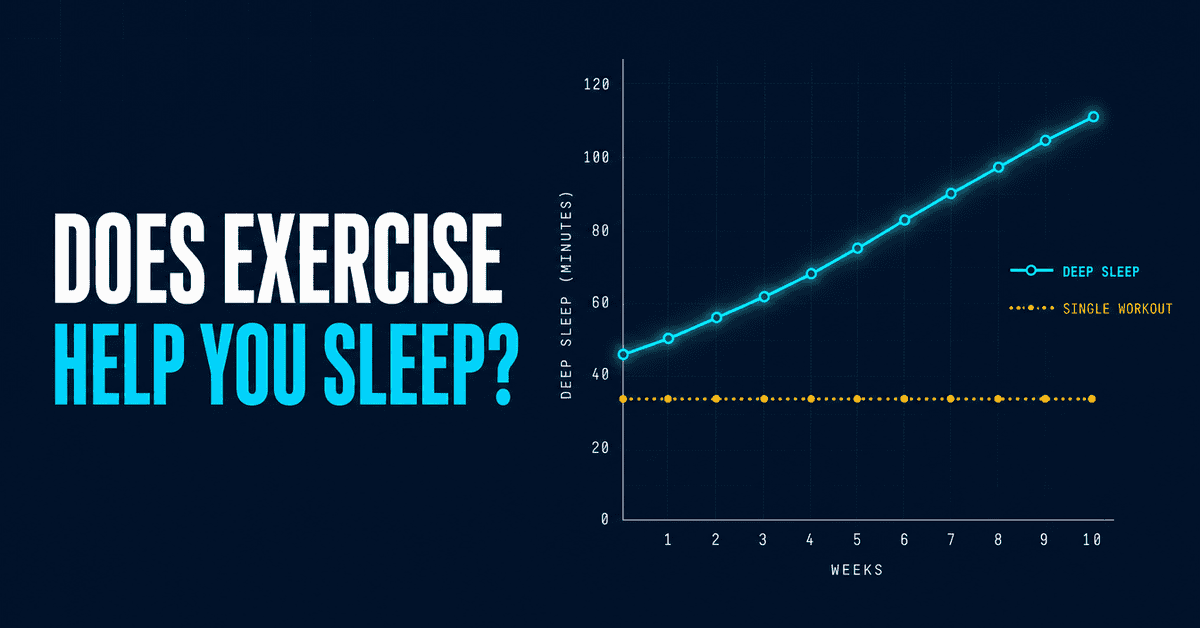
In the studies, the improvements reliably show up around nine to ten weeks in. This is a training effect on your sleep, built the same slow, dependable way you build anything else you train for. Which leads straight to the mistake almost everyone makes.
Treating one brutal workout like a guaranteed good night — “I destroyed myself today, I’ll sleep like a baby” — isn’t supported by the research. A single session’s effect on that same night is small and all over the place: studies land anywhere from slightly better to no change, depending on fitness, intensity, time of day, even how hot you got. One workout doesn’t reorganize your sleep. A habit does.
Physical tiredness is not the same as sleep readiness. Being wiped out is a feeling in your muscles. Falling asleep is your nervous system standing down. If your heart is still pounding, your body is still warm, and adrenaline is still circulating, the off-switch hasn’t flipped — no matter how exhausted you are. The exhaustion you’ve been counting on was never the thing helping you sleep.
The real lever is temperature
Falling asleep rides a drop in core body temperature. As evening comes on, your body naturally cools, and that downward slope is part of the signal that tells your brain it’s time to sleep.
Exercise does the opposite in the moment: it heats you up. Normally that’s fine — your core temperature climbs during the workout, then falls back, usually settling below where it started long before bed. That rebound can actually help you drop off faster.
Here’s the one real exception: vigorous exercise that ends within about an hour of bedtime. Finish a hard session that close to sleep and your temperature, heart rate, and arousal can all still be elevated while you’re trying to wind down — which can genuinely delay sleep onset and shave a little off quality. Notice how narrow that is: it has to be vigorous, and within roughly an hour of bed. Push the same hard session to two or more hours before bed and the disruption basically vanishes. And the fitter you are, the less it touches you — in one study, even a moderate workout right before bed raised core temperature and still didn’t measurably hurt sleep.
The “no exercise within 3 hours of bed” rule is mostly overblown
Moderate evening exercise is fine. In controlled studies it even nudges up deep sleep and trims the lightest, flimsiest stage. The biggest reality check came from a study tracking 150,000 nights of real-world data: physical activity in the three hours before bed was unrelated to how well people slept — and if anything, those people slept slightly longer and drifted off a touch earlier.
So the honest grades, in the style of our sleep-hacks report card:
- Exercise as a sleep aid: strong.
- The two-hour rule: weak.
- The only timing that reliably backfires: vigorous effort in the last hour before bed.
If you can train in the morning or early afternoon, there’s a small bonus: movement plus daylight early in the day anchors your body clock and tightens sleep timing (the same mechanism behind the fixed wake time that fixes groggy mornings). But consistency beats perfect timing every single time. The best workout schedule for your sleep is the one you’ll actually keep.
What to actually do
- Aim for about 150 minutes of moderate movement a week — roughly 30 minutes, five days. Moderate, not maximal: a brisk walk, an easy bike, a steady run. The people in these studies weren’t doing anything heroic; they were moving regularly at a comfortable effort and letting the weeks do the rest.
- Put it wherever you’ll be consistent. Mornings: take the circadian bonus and the daylight. Evenings: train anyway — keep late sessions moderate, or finish the truly hard stuff at least an hour or two before you plan to sleep. A gentle wind-down (easy walk, light stretching, slow mobility work) is the opposite of a problem; it helps you downshift.
- Judge it the way we judge everything here: not by tonight. Screenshot your baseline, run the habit for a few weeks, and watch the trend — average time to fall asleep, deep sleep, how you feel at 3 p.m. The improvement is real; it shows up on the timescale of a habit, not a single hard day.
The bottom line
You worked out hard — why aren’t you sleeping better tonight? Because tonight was never where the benefit lived. Exercise improves your sleep the same way it makes you stronger: quietly, over weeks, as a habit. Being exhausted was never the point. Stop chasing the knockout workout, stop fearing the evening session, and just move, consistently. The behaviors that help on any given night are graded in our sleep hacks article, and the highest-impact changes are collected in the free Deep Sleep Protocol on the Start Here page.
Frequently asked questions
Does exercise help you sleep better?
Yes — regular moderate exercise is one of the best-supported sleep interventions there is: faster sleep onset, less night waking, more total sleep, and more stable deep sleep. The effect builds over roughly 9–10 weeks of consistent training, not from a single session.
Is it bad to work out before bed?
Mostly no. Moderate evening exercise doesn’t harm sleep and may improve deep sleep. The one exception is vigorous, high-intensity exercise finishing within about an hour of bedtime, which can delay sleep onset because your body is still hot and aroused.
Why can’t I sleep after an intense workout?
Elevated core temperature, heart rate, and adrenaline can keep your nervous system in “on” mode for a while after a hard session. Muscle tiredness doesn’t switch that off. Finish hard sessions earlier, and let the body cool down before bed.
What is the best time of day to exercise for sleep?
Whenever you’ll do it consistently. Morning or early-afternoon training adds a small circadian bonus (movement plus daylight anchors your body clock), but consistency matters more than timing.
How much exercise do I need to improve sleep?
About 150 minutes of moderate activity per week — roughly 30 minutes on five days — at an effort where you breathe harder but aren’t destroyed. Judge results by your weekly trend after several weeks, not by the next morning.