Last night, you dreamed. Not once — four, maybe six separate times. You lived through entire worlds, had conversations, felt fear, ran. Roughly two hours of it. And this morning? Almost nothing. So if you’ve ever wondered why can’t I remember my dreams, here’s what almost everyone gets wrong: your brain did not erase them. It never saved them in the first place. Everybody asks what their dreams mean; almost nobody asks why they’re built to disappear — and that second question actually has a verified answer. The video below lays it out; this article covers how much you’re really dreaming, the chemistry that prevents the memory, what dreams are genuinely for (graded honestly), what they definitely don’t mean, and how to catch one if you want to.
You dream far more than you think
You don’t dream once a night. You cycle into REM sleep — where the most vivid dreaming happens — roughly every 90 minutes, four to six times a night, and the REM periods get longer as the night goes on. The one right before you wake can run half an hour or more, which means the longest, strangest dream of your night is usually happening just before your alarm.
Add it up and the average adult spends about two hours a night dreaming — somewhere around six years over a lifetime. And in sleep labs, when researchers wake people during REM, they report a dream 80–85% of the time (below 50% from other stages). So this isn’t “some people dream and some don’t.” You dreamed. What failed was the recall.
Why the memory never forms
Memory doesn’t happen automatically. To turn an experience into something retrievable, your brain needs a particular chemical setup, and one key ingredient is noradrenaline (norepinephrine) — it handles attention, learning, and stamping an experience down hard enough that it sticks.
During REM sleep, noradrenaline drops to essentially zero. Not low — effectively off. The chemical your brain uses to write memories is switched off during the precise window the dream is happening. That’s not a glitch; that’s the state. Instead, your cortex runs mostly on acetylcholine, which is superb at generating vivid, associative, wildly creative imagery — and useless for filing it.
There’s more. Brain imaging shows that during REM, your dorsolateral prefrontal cortex — the part that runs logic, self-reflection, and the little voice that says “wait, that doesn’t make sense” — is one of the least active regions in your head, effectively disconnected from the rest of the cortex. Which is why your dead grandmother can drive a bus through your old high school while you’re late for an exam you never enrolled in, and not one part of it strikes you as strange. The part of you that would object is not on shift.
Put it together: rich, emotional, deeply bizarre experience — with the memory-writer switched off and the critic asleep. The dream is happening. Nothing is recording it. Your dreams aren’t deleted. They were never saved. There is no lost file to recover.
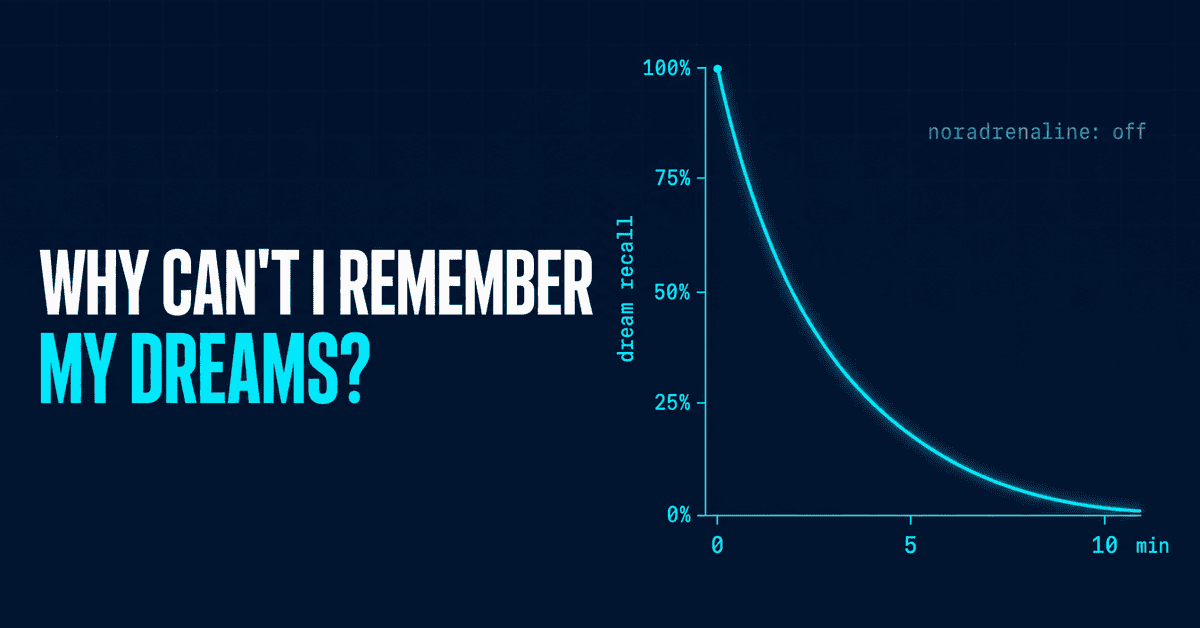
One last, elegant detail: noradrenaline comes rushing back in the few seconds right before you wake. That’s exactly why a dream feels like it’s evaporating in your hands as you surface — you’re crossing into the chemistry of being awake, and the dream has nowhere to live on this side. The clock is brutal: roughly half of a dream’s content is gone within five minutes of it ending, 90% within ten.
What dreams are for — graded honestly
We do not have one clean answer. We have several theories with different amounts of evidence, and the honest move is to grade them:
- Memory consolidation — strongest. During sleep your brain reorganizes and integrates what you took in, connecting new information to what you already know. Dreaming appears to be part of that. Most support.
- Emotional regulation (“overnight therapy”) — close behind. Dreaming lets you reprocess emotional experiences and strip some of the sting. People who reported dreaming showed the expected drop in emotional reactivity the next day; people who didn’t recall dreaming didn’t. A meaningful signal.
- Threat simulation — plausible, not proven. Dreams as a safe rehearsal space for danger. People who’ve been through trauma do dream about threats more often, but the evolutionary claim is very hard to test directly.
- Activation-synthesis — foundational, now considered incomplete. Dreams as the cortex spinning a story out of random brainstem signals.
Dreaming probably isn’t doing one job; it’s doing several at once. Anyone who tells you they know exactly what dreams are for isn’t ahead of the science — they’re just not reading it.
What dreams don’t mean
Dream dictionaries — teeth falling out means anxiety, water means emotion, falling means loss of control — are not based on research. There is no scientific consensus that dream symbols carry fixed, universal meanings, and the evidence points the other way. A dictionary cannot know what a dog means to you: adored childhood pet or the thing that bit you at six. The symbol isn’t universal. The symbol is yours.
What the research supports is the continuity hypothesis — far less mystical, far more useful. Your dreams are largely continuous with your waking life, built out of your current concerns: relationships, work, the thing you can’t stop turning over. Dreams aren’t a coded message about your life. They’re made out of your life.
One honest caveat: certain themes do recur across cultures — falling, being chased, teeth, water, nakedness, a dead loved one. That’s shared human wiring and shared human fears, not a universal codebook with fixed definitions. The useful question was never “what does this symbol mean?” It’s “what have I been carrying this week?”
How to actually remember a dream
- Target the right window. Recall from REM runs 80–90%, and REM periods are longest at the end of the night. Your best shot is the dream right before you naturally wake.
- Don’t move. When you wake, stay completely still, eyes closed. Don’t roll over, don’t reach for your phone. Movement and input flood the system and shove the fragment straight out.
- Write it down immediately. Not after coffee — immediately. Half of it is gone in five minutes. Keep an actual notebook within arm’s reach.
- Set the intention before sleep. Tell yourself, deliberately, that you’re going to remember your dream. It’s a well-studied mechanism — prospective memory — and it measurably improves recall.
- Get enough sleep — the boring one that beats all the others. REM is loaded into the back half of the night. Sleep six hours instead of eight and you don’t lose a quarter of your dreaming; you lose far more than that. (Your wearable’s REM minutes are an estimate, not a measurement — see how accurate sleep trackers are before you chase the number.)
The bottom line
We spend our lives asking what our dreams mean, while the more interesting question hides right behind it: why is the most vivid experience your mind produces designed to be thrown away? Not because it’s worthless — because the state that makes dreaming possible (a brain running wild, the critic offline, the memory-writer switched off) is the same state that makes remembering it impossible. The forgetting isn’t a flaw in the system. It’s the receipt. Something useful already happened up there; you just don’t get to keep the footage. For what happens when the wall between dreaming and waking breaks down — your mind wakes but your body doesn’t — read the sleep paralysis explainer. And the toolkit that protects all the REM you’re doing this work in is the free Deep Sleep Protocol on the Start Here page.
Frequently asked questions
Why can’t I remember my dreams?
Because during REM sleep the brain chemical needed to write memories — noradrenaline — is effectively switched off, and the prefrontal cortex that would flag and file the experience is offline. The dream happens; it’s simply never recorded. Half of any dream is gone within five minutes of ending.
Does not remembering dreams mean I don’t dream?
No. Lab studies show people woken from REM report a dream 80–85% of the time, regardless of whether they normally recall dreams. Everyone dreams roughly two hours a night; recall is what varies.
How can I remember my dreams more often?
Stay completely still on waking, write the dream down immediately, set a deliberate intention before sleep, and — most effective — get a full night’s sleep so you don’t cut the long REM periods at the end of the night.
Are dream dictionaries accurate?
No. There’s no research support for fixed, universal dream symbols. The best-supported view is the continuity hypothesis: dreams are built from your own waking concerns, so a symbol’s meaning is personal, not universal.
Is it bad to remember every dream?
Frequent vivid recall often just means you’re waking during or right after REM — common with fragmented or light sleep. It’s not harmful in itself, but if it comes with feeling unrefreshed, it’s worth looking at sleep continuity.