You’re tired in the afternoon, so you lie down for a quick nap. You close your eyes for what feels like a few minutes — and wake up fifty minutes later feeling worse than before you lay down. Heavy, foggy, almost hungover. So you decide naps just don’t work for you. That’s the wrong conclusion. The question isn’t whether to nap; it’s how long should a nap be — because that ruined feeling wasn’t bad luck or a broken body. It was a timer. You woke at exactly the wrong moment, and once you understand the two dials that control a nap, you never have to wake up like that again. The video below explains the machinery; this article gives you the lengths, the timing window, who naps help and hurt, and the coffee-nap trick.
A nap is a bet on the same tank you need tonight
From the moment you wake, your brain builds sleep pressure, driven by a molecule called adenosine. It accumulates the whole time you’re awake — a tank slowly filling — and at night, sleeping drains the tank back down. (It’s the same gauge caffeine tapes over; see how long caffeine stays in your system.)
Here’s the key thing most people never connect: a nap drains that same tank. When you nap you’re discharging real sleep pressure — the exact pressure that’s supposed to put you to sleep tonight. That’s why a good nap feels refreshing, and it’s also why a nap can backfire in two completely different ways. Both are a dial you control.
Dial one: length — and why 50 minutes is the trap
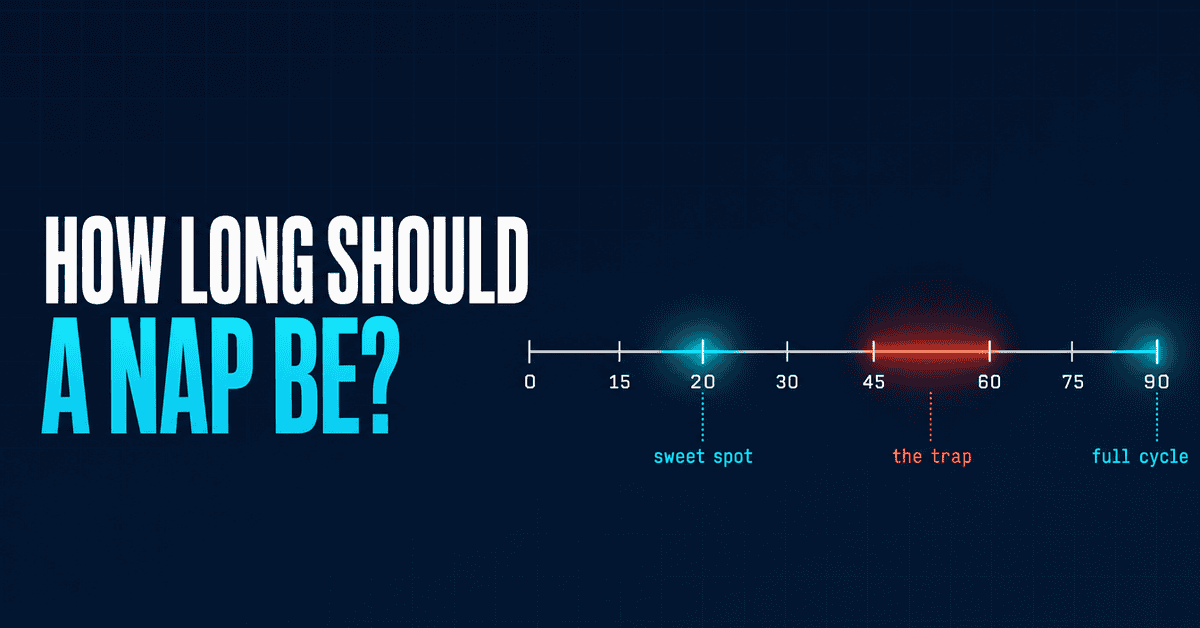
When you fall asleep you don’t drop straight into deep sleep. For roughly the first 20 minutes you’re in light sleep — easy to wake from. This is the sweet spot. Wake here and you feel sharp, alert, refreshed. But around the 20-minute mark you start sinking into deep, slow-wave sleep — the heavy, restorative stuff your body does not want to be pulled out of.
The mistake is thinking longer is automatically better. It’s the opposite. A nap of about 45–60 minutes is genuinely the worst option available: long enough to drag you deep into slow-wave sleep, too short to let you climb back out. Your alarm yanks you out of the deepest part of the cycle at the worst moment. That heavy, hungover feeling is sleep inertia, and the rule is simple: the deeper the stage you’re pulled from, the stronger and longer the grogginess. From light sleep, almost none. From deep sleep, it can hang on for 15 minutes to a full hour. (The same mechanism explains a lot of groggy mornings after a full night.)
The other safe option is a full cycle — about 90 minutes. Sleep a complete cycle and you come all the way back around to light sleep before waking, so you surface gently. So there are two good nap lengths: short (~20 minutes) or long (~90 minutes). It’s everything in the murky middle that wrecks you.
Dial two: timing — the one that hits you at midnight
There’s a genuinely good window, and it’s built into your biology. Your body clock produces a second, smaller dip in alertness in the early afternoon — roughly 1–3 p.m. You know it as the post-lunch slump. And it isn’t caused by lunch: researchers have had people skip the meal entirely, and the dip shows up anyway, right on schedule. It’s your circadian clock running its afternoon low — a natural window where your body is already primed to nap, and napping there costs you the least.
Nap outside that window — late afternoon, early evening — and you hit the timing problem. Remember the tank: nap at 6 p.m. and you’re pouring out the very pressure that was supposed to make you sleepy at eleven. Studies that split sleep between a nap and the night find it measurably lowers the deep-sleep drive at night. You reach bedtime with a half-empty tank, lie there wide awake, and blame insomnia — when the afternoon nap was the first domino.
Who naps help — and who they hurt
They help the sleep-deprived: shift workers, anyone running a real deficit. The evidence is remarkable. NASA studied long-haul pilots on transpacific flights and let some take a planned cockpit nap while a colleague flew. On average they fell asleep in under six minutes and slept about 26. That short nap improved reaction-time performance by 34% and physiological alertness — fewer micro-sleeps on EEG — by 54%.
They hurt people who already sleep badly at night. If you have insomnia, a daytime nap isn’t the cure — it’s part of the problem, bleeding off the sleep pressure you desperately need at bedtime. One of the most effective insomnia treatments, sleep restriction therapy, forbids daytime napping entirely, precisely to let that pressure build. If you need a nap every single day just to function, treat that as a signal that your night sleep isn’t doing its job, not as a habit to optimize.
How to take a nap that works
- Length: 10–20 minutes. Set an alarm. You want to wake before you sink into deep sleep — you’re topping up alertness, not running a full sleep program. (Have the time? A full 90-minute cycle is the other safe choice.)
- Timing: early afternoon, before about 3 p.m. Early enough that it doesn’t touch tonight.
- The coffee nap. Caffeine takes 20–30 minutes to kick in, so drink a coffee right before your 20-minute nap. You fall asleep before it hits, get the restorative benefit of the short nap, and wake right as the caffeine comes online — both effects stacked. In studies, caffeine before a short nap boosted its alerting effect, and a short afternoon nap can beat a moderate dose of evening caffeine for cutting sleepiness. Keep the coffee inside your six-hour caffeine cutoff, and the nap inside the 1–3 p.m. window, and the trick costs tonight nothing.
The bottom line
That 50-minute disaster that made you swear off napping wasn’t naps failing you. It was an untuned instrument. A nap has two dials — length and timing — and the moment you set them on purpose instead of by accident, it stops being a gamble and becomes one of the most reliable tools you have. Twenty minutes, early afternoon. Or a full 90-minute cycle if you’ve got the time. Never the murky middle, never late in the day. And if you find you need the rescue nap most days, the fix is the night itself — the free Deep Sleep Protocol on the Start Here page is where to start.
Frequently asked questions
How long should a nap be?
Either 10–20 minutes (wake from light sleep, minimal grogginess) or a full ~90-minute cycle. Avoid 45–60 minutes — that’s long enough to enter deep sleep but too short to complete the cycle, so you wake with heavy sleep inertia.
Why do I feel worse after a nap?
You were woken from deep slow-wave sleep, which produces sleep inertia — grogginess that can last 15 minutes to an hour. Naps in the 45–60-minute range are the most common cause. Shorten to 20 minutes or extend to 90.
What is the best time of day to nap?
Early afternoon, roughly 1–3 p.m., during the body clock’s natural alertness dip. Napping later than about 3 p.m. drains the sleep pressure you need at bedtime and can make it harder to fall asleep that night.
Are naps bad for you?
Not for most people — a well-timed 20-minute nap measurably improves alertness and performance. They’re counterproductive for people with insomnia, because they reduce nighttime sleep drive, which is why insomnia treatments typically ban daytime napping.
What is a coffee nap and does it work?
Drinking a coffee immediately before a 20-minute nap. Caffeine takes 20–30 minutes to act, so you wake just as it kicks in, stacking the nap’s restorative effect with caffeine’s alerting effect. Studies show the combination boosts alertness more than either alone.