You had a coffee at two in the afternoon. It’s eleven at night and you’re lying in the dark, wide awake, wondering why. Those two facts are connected — but almost certainly not the way you think. The first thing to understand about how long caffeine stays in your system is that there is no energy in it. None. Not a single calorie of usable fuel. Caffeine has never once made you less tired; what it does is take away your ability to notice how tired you already are. The video below walks through the mechanism; this article gives you the half-life math, the study that shows caffeine hiding its own damage, and the rules for using it without paying for it at night. This is not a post about quitting coffee.
What caffeine actually does
All day, while your brain runs, it produces a molecule called adenosine. It accumulates hour by hour and docks into receptors in your brain — think of each docking as a click of pressure. That’s sleep pressure: the thing that makes your eyelids heavy at eleven at night and doesn’t at eleven in the morning. Adenosine isn’t a poison. It’s a gauge — your brain’s honest report on how long you’ve been awake.
Caffeine is shaped just enough like adenosine to fit into those same receptors — but it doesn’t activate them. It just sits there. Pharmacologists call this an antagonist: it occupies the lock without turning the key. Adenosine shows up, ready to deliver its message, and finds every parking spot taken.
Your brain does not stop making adenosine while caffeine is in the way. The tiredness keeps accumulating, piling up behind the block. You don’t feel less tired — you lose the ability to feel it. The gauge didn’t go down. Somebody put tape over the gauge.
How long caffeine stays in your system: the half-life math
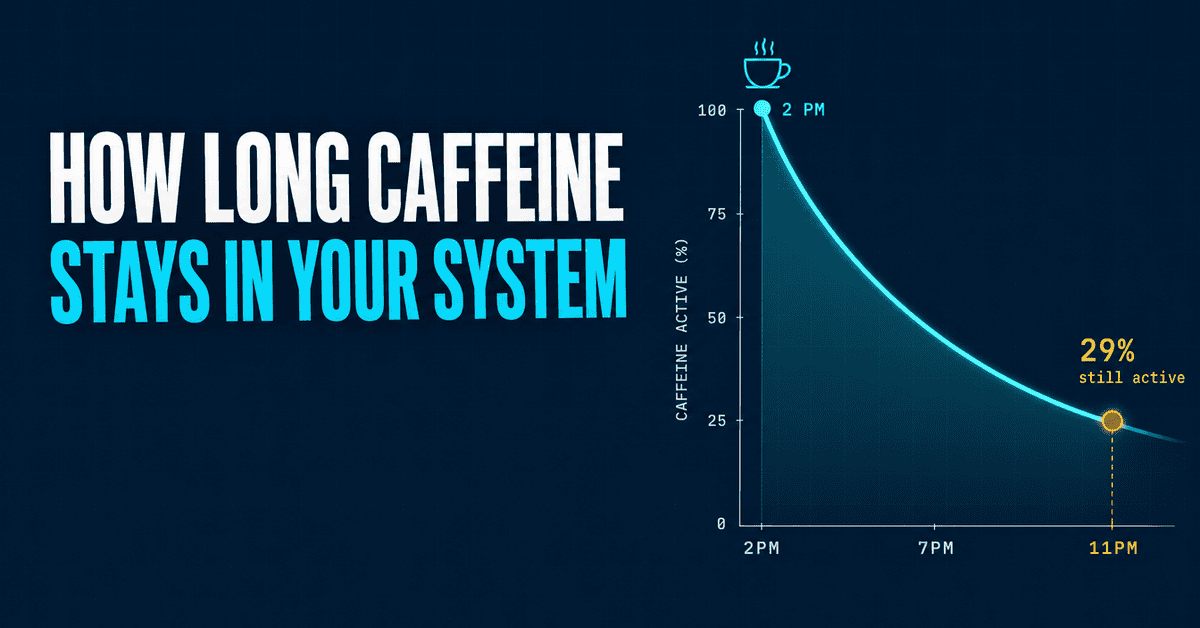
Caffeine’s half-life — the time your body takes to clear half of it — is somewhere between three and seven hours in healthy adults, averaging about five. So do the math on that 2 p.m. coffee (a standard brewed cup, ~95 mg):
- 7 p.m.: roughly half of it is gone — which means half of it isn’t.
- 11 p.m.: about 29% of the dose is still circulating. Not “a trace.” Nearly a third, still occupying receptors while you wonder why you can’t drift off.
And five hours is an average — you are not an average. Caffeine is broken down almost entirely by a single liver enzyme, CYP1A2, and how fast your version works is largely genetic: measured clearance varies up to 40-fold between individuals. Smokers clear caffeine 30–50% faster. Oral contraceptives roughly double the half-life. Pregnancy, body weight, even altitude shift it. So when your friend says “coffee doesn’t affect my sleep,” they may be telling the truth — about themselves. Their half-life might be three hours where yours is seven. This isn’t willpower. It’s an enzyme.
“I fall asleep fine after coffee” — the study that changes everything
In 2013, Christopher Drake’s team (Journal of Clinical Sleep Medicine) gave healthy normal sleepers 400 mg of caffeine — roughly two to three cups — at bedtime, three hours before bed, and six hours before bed, then measured what happened to their sleep.
All three timings significantly disrupted sleep. Even the six-hours-before group lost more than an hour of total sleep. And here’s the most important finding in this entire article: those people did not know. Their own subjective reports failed to detect the disruption. They lost over an hour of sleep and reported feeling fine about it.
The same molecule that hides your tiredness also hides the damage it’s doing to your sleep. “I sleep fine on coffee” is exactly what the people who lost an hour of sleep also said. Caffeine specifically disables the instrument you’d use to detect the problem. And it isn’t only duration: evening caffeine lengthens sleep onset, cuts total sleep, and measurably reduces slow-wave activity — the deepest, most restorative part of the night. You can be asleep for eight hours and get a thinner, shallower version of it.
Honest limits: twelve participants is a small sample, and 400 mg in one hit is a decent dose — this isn’t “one macchiato destroys your night.” But the direction is unambiguous, it has held up, and it’s the basis for the six-hour rule below.
The crash and tolerance — held a little more loosely
The 2–3 p.m. cliff after a morning cup? The leading explanation: when caffeine finally clears the receptors, all the adenosine that piled up behind the block arrives at once — every message held at the door delivered in the same moment. You didn’t lose energy; you got handed the bill. It’s consistent with everything we know about adenosine, but the primary evidence is thinner than the sleep data, so hold it as “leading,” not “proven.”
Same for tolerance. The story is that a constantly blocked brain builds more adenosine receptors (upregulation), so the same cup covers a smaller fraction and you need more to reach baseline. Tidy — but the solid evidence comes from rodent studies. Call it a well-supported hypothesis in humans, not a settled fact.
How to use caffeine without paying for it at night
- Give it a six-hour buffer. That’s not a round number someone made up — it’s where Drake’s data lands. Bed at eleven means a hard stop at 5 p.m. Slow metabolizer, or on the pill? Push it earlier. Your enzyme, your cutoff.
- Respect the ceiling. The FDA puts 400 mg/day as the amount not generally associated with negative effects for healthy adults — about four 8-oz cups of brewed coffee. Pregnant or breastfeeding: 200 mg. And know your sources: brewed coffee ~95 mg, an espresso shot ~63, a Red Bull ~80 — but in one analysis of real café servings, an Americano averaged 143 mg while a light pour-over came in at 23. Six-fold difference, same word on the menu.
- Stop using caffeine to paper over a sleep debt you keep re-borrowing. The afternoon cup isn’t free. It’s a loan against tonight, at an interest rate you can’t feel. If afternoons are the problem, a correctly timed 20-minute nap beats a moderate evening dose of caffeine for cutting sleepiness — and you can stack the two as a “coffee nap.”
The complete system
The Caffeine & Sleep Guide ($17) turns this article into a personal protocol: a 38-page sourced guide, a cutoff calculator that computes your own hard stop from your clearance speed, and a printable toolkit with the 3-night speed test and 5-day tolerance reset. Get the kit →
(And the viral morning rule — delay your first coffee 90 minutes after waking? Plausible mechanism, thin evidence. We graded it in why you wake up tired after 8 hours. The rule that matters is the afternoon one.)
The bottom line
Caffeine isn’t the villain. It’s one of the most useful, best-studied, safest tools we have. But it’s not fuel — it’s a mute button on a signal your body is sending for a reason, and the signal keeps building right up until the tape comes off. Use it early, use it on purpose, and when you reach for the afternoon cup that will cost you an hour of tonight’s sleep — a cost you now know you won’t be able to feel — make it a decision instead of a reflex. Caffeine timing is one of the highest-leverage items in the free Deep Sleep Protocol on the Start Here page, and if you want a cutoff calculated for your own wake time, chronotype, and wearable, that’s exactly what the Protocol Engine builds in Module 3.
Frequently asked questions
How long does caffeine stay in your system?
Its half-life is 3–7 hours (average ~5) in healthy adults, so a 2 p.m. cup still leaves about 29% of the dose circulating at 11 p.m. Genetics (the CYP1A2 enzyme), smoking, oral contraceptives, and pregnancy can shift clearance dramatically — up to 40-fold between people.
How many hours before bed should I stop drinking coffee?
At least six. In a controlled study, 400 mg of caffeine taken six hours before bed still cost participants more than an hour of measured sleep. If you metabolize caffeine slowly, extend the buffer further.
Does caffeine affect sleep even if I fall asleep fine?
Yes. In the same study, participants lost over an hour of sleep and had reduced deep sleep but did not notice — their subjective reports missed the disruption entirely. Caffeine blunts your ability to perceive its own effect on your sleep.
How much caffeine is too much?
The FDA considers up to 400 mg/day (about four 8-oz brewed cups) generally safe for healthy adults, and 200 mg during pregnancy or breastfeeding. Café servings vary enormously — an Americano can carry six times the caffeine of a light pour-over.
Why do I crash after coffee?
The leading explanation is that adenosine keeps accumulating behind caffeine’s block, and when caffeine clears, all of it reaches your receptors at once. The mechanism is plausible and widely cited, though direct human evidence is thinner than for caffeine’s sleep effects.