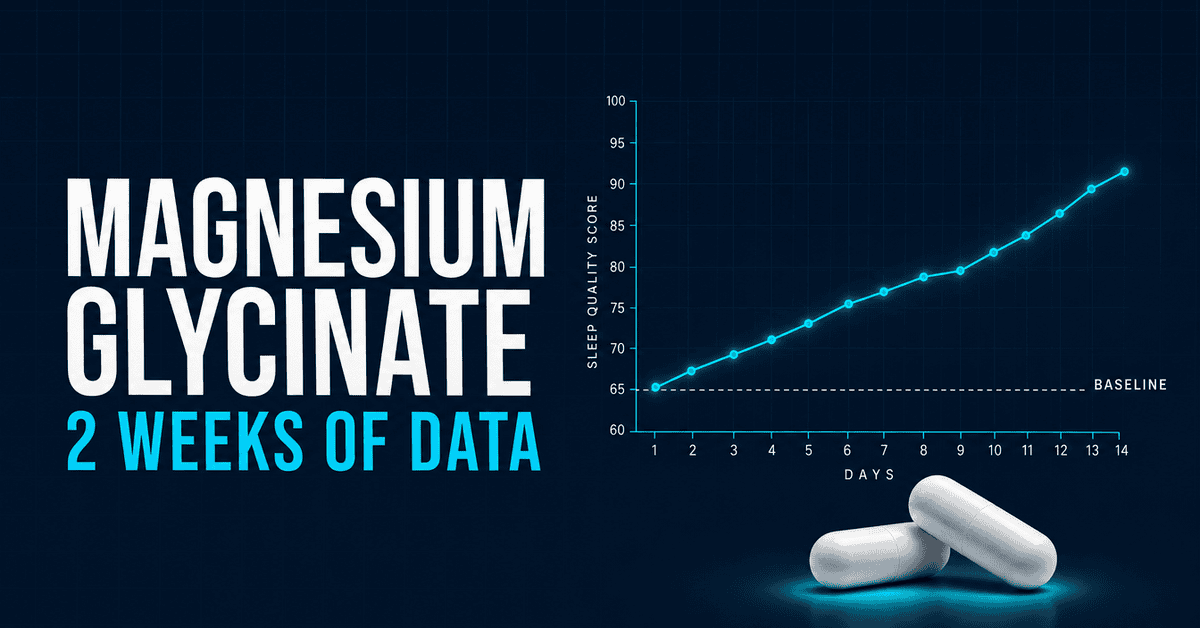
Of every supplement in the sleep aisle, one keeps surviving scrutiny: magnesium glycinate for sleep. It’s the form we recommend by default, the one with the friendliest side-effect profile, and the one whose mechanism actually holds up. But does it move real sleep data on a real wearable? We ran exactly that experiment — two weeks, tracked nightly — in the video below. This article covers the rest: why glycinate beats the other forms, what the research supports, the correct dose, and how to run the same two-week test on yourself.
Why glycinate, specifically?
Magnesium never comes alone — it’s always bound to a carrier molecule, and the carrier decides almost everything: how much you absorb, how your gut tolerates it, and what else comes along for the ride. Glycinate binds magnesium to glycine, and that pairing wins on three fronts:
- High absorption. Chelated magnesium survives the gut and actually reaches your bloodstream — unlike magnesium oxide, which absorbs at roughly 4% and works mostly as a laxative.
- Gentle on the gut. The classic high-dose magnesium side effects (loose stools, cramping) are largely a story about unabsorbed magnesium sitting in the intestine. Glycinate’s efficiency keeps that to a minimum — it’s the form people actually tolerate nightly.
- The glycine isn’t dead weight. Glycine is itself an inhibitory neurotransmitter, and studies of glycine taken before bed suggest modest improvements in subjective sleep quality and next-day alertness. You’re effectively taking two mildly sleep-relevant compounds in one capsule.
The mechanism side is the same story we covered in the magnesium dosage deep-dive: magnesium supports GABA signalling (the brain’s off-switch), dampens excitatory NMDA activity (the racing-mind pathway), and serves as a cofactor in melatonin synthesis. Three real mechanisms — all of which matter most when your magnesium status is low to begin with.
What the evidence actually supports
Honest framing, because this is where most supplement content oversells: the clinical evidence for magnesium and sleep is promising but modest, and strongest in people who start out deficient — older adults, heavy trainers, heavy drinkers, PPI users, and people with low dietary intake. The most-cited randomized trial (Abbasi et al., 2012) found improved sleep time, efficiency, and melatonin levels with nightly magnesium — in older adults with insomnia who were largely deficient.
The realistic model: magnesium glycinate is a correction, not a sedative. If low magnesium is your bottleneck, fixing it shows up in your data within two weeks. If it isn’t, glycinate won’t knock you out — and that’s exactly what an honest supplement should look like.
The label trap: elemental magnesium
The single most common mistake with glycinate is dosing by the compound weight. Magnesium glycinate is mostly glycine by mass — a “400 mg magnesium glycinate” capsule typically contains only around 58 mg of elemental magnesium. Check the label for the words “elemental magnesium” in the supplement facts panel; that’s the only number that counts. Reputable brands state it plainly. Brands that bury it are telling you something.
Dose and timing
- Start at 200 mg elemental, 45–60 minutes before your target bedtime.
- Hold for two weeks and judge by your wearable trend, not by any single night.
- Move to 300 mg only if sleep latency is still elevated and your gut is untroubled.
- Stay under the NIH supplemental ceiling of 350 mg/day unless a clinician says otherwise — the full safety picture, including who shouldn’t supplement at all (kidney disease, certain antibiotics, PPIs, diuretics, pregnancy), is in the dosage article.
The complete step-by-step version — including what to stack it with and how to schedule it inside your wind-down — is our Magnesium Sleep Protocol.
Run the two-week test yourself
This is the part most supplement articles skip: you can verify magnesium glycinate on your own body with the same n=1 protocol from the video.
- Week 0–2 (baseline): no magnesium. Log nightly: sleep latency, deep sleep minutes, HRV, overnight resting heart rate, and wake episodes. No other changes.
- Week 2–4 (test): 200 mg elemental glycinate, 45–60 minutes before bed, every night. Same bedtime, same caffeine cutoff — one variable.
- Judge the averages, not the nights. Compare the two-week means. Meaningful signals: latency down, HRV trending up, fewer wake episodes. (Stage minutes are estimates — calibrate expectations with how accurate sleep trackers are.)
- Interpret honestly. Clear improvement → you were probably running low; keep it. Nothing after four weeks → magnesium wasn’t your bottleneck. Stop paying for it and pull a different lever — temperature, light, caffeine timing, or the wind-down.
The bottom line
Magnesium glycinate is the best-supported form of magnesium for sleep: absorbed well, tolerated nightly, paired with a carrier amino acid that’s mildly sleep-positive in its own right. The evidence says it works meaningfully when you’re deficient and modestly-to-not-at-all when you’re not — so treat it like the testable intervention it is. 200 mg elemental, 45–60 minutes before bed, two-week baseline versus two-week test, and let your own data give the verdict. That’s the SleepMetric way — and if the data says no, the rest of the Biohacker Brief protocols are where to look next.
Frequently asked questions
How much magnesium glycinate should I take for sleep?
Start with 200 mg of elemental magnesium (check the supplement facts panel — compound weight is mostly glycine), taken 45–60 minutes before bed. Increase to 300 mg only if needed and tolerated, and stay under the NIH’s 350 mg/day supplemental ceiling without medical guidance.
How long does magnesium glycinate take to work for sleep?
Think weeks, not nights. Magnesium status changes gradually, so run a fair test: two weeks nightly, judged against a two-week baseline on your wearable’s averages. If nothing has moved by week four, it likely isn’t your limiting factor.
Is magnesium glycinate better than melatonin for sleep?
They do different jobs. Melatonin is a circadian timing signal — useful for jet lag and schedule shifts, weak as a nightly sleeping aid. Magnesium glycinate supports the neurochemistry of sleep depth and calm arousal, and helps most when you’re deficient. For a stressed, under-slept professional, glycinate plus the behavioural fundamentals is usually the better first experiment.
Does magnesium glycinate have side effects?
It’s the gentlest common form — that’s much of its appeal. At sensible doses most people notice nothing but (sometimes) calmer evenings. Very high doses can still cause GI upset, and people with kidney disease or on interacting medications (fluoroquinolones, tetracyclines, PPIs, diuretics) should involve their doctor before supplementing.
Can I take magnesium glycinate every night?
For most healthy adults, yes — it’s well suited to nightly use at 200–300 mg elemental. The better question is whether you should: run the two-week test, and keep it only if your data improves.