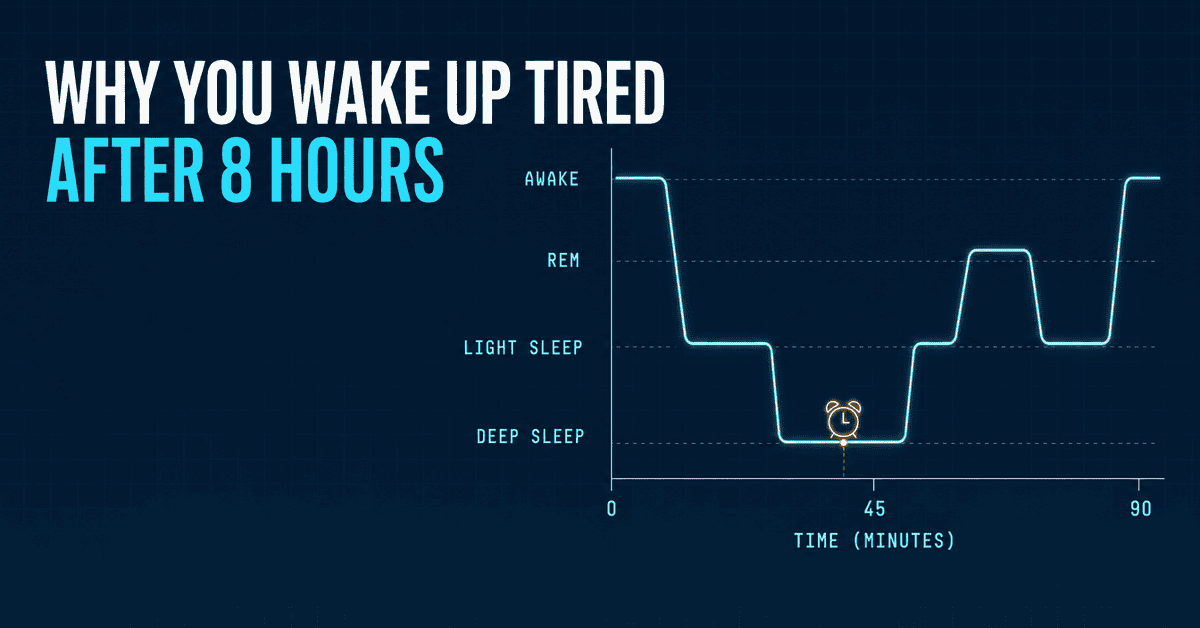
You slept a full eight hours. The tracker confirmed it. And you still woke up feeling like you’d been hit by a truck. So you do the math everyone does: I must need more sleep. But if you’re asking why do I wake up tired after 8 hours of sleep, the data has an answer you probably haven’t heard — the problem usually isn’t how long you slept. It’s the moment you woke up. Grogginess and sleep length are two different measurements, and most of us spend all our attention on the wrong one. The video below walks through the whole argument; this article gives you the mechanism, honest grades on the popular fixes, and the seven-day reset.
That groggy feeling has a name: sleep inertia
The heavy limbs, the foggy thinking, the urge to crawl back under the covers — that’s sleep inertia, and it is universal. Everyone gets it. It is not a sign your night failed.
Here’s what’s happening under the hood. While you sleep, adenosine — the molecule that builds up all day and makes you feel sleepy — gets cleared out. But it doesn’t finish clearing the instant your alarm goes off. And your prefrontal cortex, the region that handles decisions and focus, is one of the last parts of the brain to fully switch back on. For a window after waking, you’re running on a brain that’s still booting up.
For most people that window is 15–30 minutes. Under the wrong conditions it can stretch past an hour. Either way, feeling terrible at 7:01 tells you almost nothing about your night. Judging your sleep by the first five minutes awake is like judging a car by the first turn of a cold engine.
The variable that actually predicts grogginess
Not how long you slept — where in the sleep cycle your alarm caught you.
Your night isn’t flat. You move through cycles of roughly 90 minutes, and inside each one you pass through light sleep, deep sleep, and REM. The stage you’re in when you wake changes everything about how you feel:
- Yanked out of deep sleep (the heavy slow-wave stage your body front-loads early in the night) → inertia at its worst. That’s the drugged, cement-in-the-veins feeling.
- Woken from light sleep or REM → the same eight hours feel mild, quick, almost clean.
That’s the real reason two people with identical sleep totals wake up feeling like they lived different nights. One got caught mid-deep-sleep. The other didn’t.
This is exactly what “smart alarms” and wake-window features promise to solve — wake you during a light phase inside a set range. The idea is sound and the mechanism is real. The weak link is detection: a wrist tracker is guessing your stage from movement and heart rate, and as we covered in how accurate sleep trackers really are, that guess is often wrong. A good idea sitting on a shaky measurement — useful sometimes, reliable not yet.
The usual suspects, graded honestly
- An irregular wake time — the #1 culprit, and it’s not close. Sleeping until nine on the weekend and up at six on Monday gives your body clock the equivalent of a flight to another time zone every week. Researchers call it social jetlag. It’s the strongest, most repeatable finding in the whole topic.
- Alcohol and late meals — real. A nightcap helps you fall asleep and then fractures the back half of the night, cutting into REM (it’s one of the top causes of 3 a.m. waking). Eat heavy and late and your body is running digestion when it should be cooling down.
- Weekend catch-up sleep — partial credit. Extra sleep does repay some of the debt (the research is genuinely mixed on how much), but it does it by wrecking the wake-time consistency that matters most. You’re paying down one debt with another card.
- The snooze button — less harmful than claimed. A 2023 study found 30 minutes of snoozing didn’t measurably harm sleep, and for some people it eased the grogginess of waking. Not a licence for an hour of it — but the panic over a nine-minute reprieve isn’t well supported.
One serious note. If you wake up exhausted every single day no matter what you change — especially if you snore loudly, gasp, or stop breathing in the night — that is not a routine problem. It’s a red flag for sleep apnea, and it’s a conversation with a doctor, not a blog post.
Four levers that actually work, in order of impact
1. A fixed wake time, seven days a week
Same time Saturday as Tuesday. This is the anchor the entire body clock hangs on and the single highest-leverage change available. Boring, free, and it beats every gadget.
2. Light, fast
Get bright light into your eyes within the first 30–60 minutes of waking — and the numbers are dramatic. Outdoor morning light, even under grey overcast, delivers on the order of 10,000 lux. A bright indoor room? Maybe 300–500. Stepping outside isn’t a little better than your kitchen; it’s in a different universe, and it’s the fastest way to tell your brain the day has started.
3. Move
Even a few minutes of light activity raises body temperature and heart rate and burns off the last of the inertia. Movement beats willpower — you’re not deciding to feel awake, you’re triggering it.
4. The 90-minute coffee delay — graded fairly
The viral advice says wait 90 minutes after waking before your first coffee. The mechanism is plausible: caffeine blocks adenosine, and cortisol is already high right after waking, so the theory says you get more out of coffee later. But the direct evidence that this improves alertness or sleep is thin. If delaying works for you, great. If it doesn’t, drink your coffee when you enjoy it — and if you want the real rules for caffeine, they’re about the afternoon, not the morning (see how long caffeine actually stays in your system).
The seven-day reset
Run this for one week:
- Pick one wake time and hold it every day, weekend included.
- Within 30–60 minutes, get outside into real daylight — even a few minutes counts.
- Add two or three minutes of easy movement.
- Leave the tracker’s sleep score alone — that’s not the number you’re testing.
What you actually watch is how long the grogginess lasts. Not your sleep score, not your total hours. Time, roughly, how many minutes it takes to feel genuinely awake — day one versus day seven. That number is your real result, and for most people it starts dropping within the week.
The bottom line
Why do you wake up tired after eight hours? Usually because your alarm caught you in the wrong part of the cycle, and your wake time swings too much for your body clock to ever settle. Notice what didn’t make that answer: sleep more. Stop asking “did I sleep enough?” and start asking “did I wake at the right time — and at the same time every day?” That reframe changes mornings more than any supplement or gadget. The highest-impact changes, all in one place, are in the free Deep Sleep Protocol on the Start Here page.
Frequently asked questions
Why do I wake up tired even after 8 hours of sleep?
Most often because of sleep inertia made worse by waking from deep sleep, combined with an inconsistent wake time that keeps your body clock permanently jet-lagged. Less often: alcohol, late meals, or — if it’s every day with snoring or gasping — sleep apnea, which needs a doctor.
How long does sleep inertia last?
Typically 15–30 minutes. It can exceed an hour if you were woken from deep sleep, are sleep-deprived, or your wake time is erratic. A consistent wake time plus bright morning light shortens it within days.
Do smart alarms that wake you in light sleep work?
The idea is sound — waking from light sleep produces far less grogginess. The limitation is that wrist trackers estimate sleep stages indirectly and are frequently wrong, so results are inconsistent. Treat them as a bonus, not a fix.
Is it bad to hit snooze?
Not as bad as the internet says. A 2023 study found around 30 minutes of snoozing didn’t harm sleep quality and eased waking for some people. Long snooze marathons still fragment the end of your night, so keep it short.
Should I sleep in on weekends to catch up?
It repays some sleep debt but costs you wake-time consistency — the single most important factor. A better trade: keep the wake time fixed and go to bed earlier if you need the extra sleep.