You wake up in the dark. You’re fully awake — you can see your room, you can think clearly. But you can’t move. Not a finger. And then you feel it: something is in the room with you, close, pressing down on your chest, and you can’t even scream. That’s sleep paralysis — one of the most frightening things a human being can experience, and also completely harmless. The gap between how terrifying it feels and how harmless it actually is, is the whole reason for this article. Sleep paralysis isn’t a curse, a haunting, or a sign something is broken in you. It’s a glitch — a very specific, very explainable glitch between two states your brain moves through every night. The video below takes the fear apart; this article covers the mechanism, why your brain builds a demon out of an empty room, the triggers, and exactly what to do next time.
Your brain paralyzes you every night — on purpose
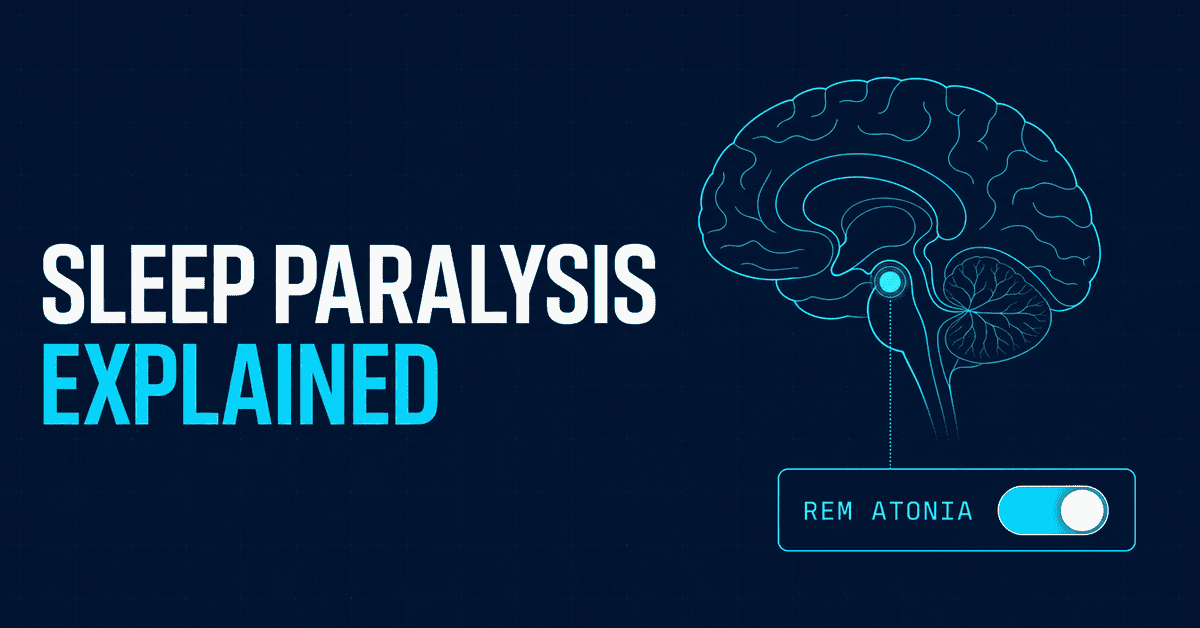
Every night, when you enter REM sleep — the stage where you dream most vividly — your brain does something remarkable. Deep in the brainstem, a cluster of cells floods the muscles that move your body with two chemicals, GABA and glycine, that switch those muscles off. Your motor neurons go quiet. You lie completely still. This is called REM atonia, and it is exactly what’s supposed to happen.
It’s a safety feature. It’s what stops you from physically acting out your dreams — running, swinging your fists, leaping out of bed mid-nightmare. When the system fails, people really do act out their dreams and hurt themselves doing it. So every night, quietly, this switch is protecting you.
Sleep paralysis is a timing slip
Normally the paralysis switches off a beat before your mind wakes up, so you never notice it was there. Sleep paralysis is what happens when the timing slips — your conscious mind boots up while the paralysis is still running. Your brain is awake. Your body is still in REM. For a few seconds you are a fully conscious person locked inside a sleeping body.
That’s it. That’s the whole phenomenon. Everything else — the fear, the figure, the pressure on your chest — is what your waking mind does with that impossible situation.
Why a demon? Why not just wait calmly?
Because of what else is switched on. Stuck in this state, your brain is still partly in REM — still dreaming — and one structure in particular is wide awake: the amygdala, your threat detector. Its entire job is to scan for danger and sound the alarm, and right now it’s screaming: you are paralyzed and helpless, and it has no information to tell it whether you’re actually in danger. So it does what it’s built to do under uncertainty — assume the worst and manufacture a threat. Your dreaming visual system obliges, painting that threat directly into your real bedroom.
This is why the hallucinations are so specific and so consistent. Researchers sort them into three types:
- The intruder — an overwhelming sense of a presence, a shadowy figure, footsteps.
- The incubus — crushing pressure on the chest, the feeling you can’t breathe. This one has a physical root: REM breathing is naturally shallow, and your terrified, paralyzed brain reinterprets it as something sitting on top of you.
- Vestibular-motor — floating, falling, flying, the sense of leaving your body.
The same demon shows up across the entire world: the Old Hag in Newfoundland, the incubus in medieval Europe, kanashibari (“bound in metal”) in Japan. Different cultures, different centuries, no contact between them — the same figure, the same chest pressure, the same terror. It was never folklore. It’s the same brain running the same emergency program in every human head.
Who gets it, and why
It can happen to almost anyone, but some things make it far more likely:
- Not enough sleep, and an irregular schedule — the biggest trigger. Disrupted sleep pushes your REM cycles around and destabilizes them, and those messy transitions are exactly where paralysis sneaks in. That’s why students, shift workers, and people fighting jet lag report it so often.
- Sleeping on your back. For reasons not fully understood, episodes happen far more often face-up.
- Stress, anxiety, and trauma all raise the odds — and it can run in families.
- Certain conditions: up to half of people with narcolepsy experience it, and it’s common alongside sleep apnea, panic disorder, and PTSD.
If you’re getting it constantly, that’s worth a conversation with a doctor — not because sleep paralysis is dangerous, but because it can be a flag for something else worth treating.
Is it going to hurt me? No.
Sleep paralysis is harmless. You are not choking. You are not dying. Nothing is in the room. Your awareness is intact, your body is fine, and the episode ends on its own — usually within seconds, at most a couple of minutes — the instant the paralysis finishes switching off.
And you are not alone. When researchers pooled data across more than 36,000 people, roughly one in thirteen had experienced sleep paralysis at least once. Among students it’s more than one in four. It’s one of the most common frightening experiences the human body produces — and almost everyone who has it is convinced, in the moment, that it’s happening only to them.
What to do in the moment
The instinct is to fight — to throw everything you have into moving. Don’t. Fighting the full-body paralysis does nothing but spike your panic, which feeds the amygdala, which makes the whole thing feel longer and worse. It isn’t a battle of strength.
- Go small. Try to move one tiny thing — a fingertip, a toe, your tongue, your eyes. That small, focused effort is often enough to tip your body back into full wakefulness.
- Slow your breathing on purpose.
- Name it. Tell yourself: this is REM atonia, it is harmless, it will pass in seconds. Naming it drains its power.
How to stop sleep paralysis from coming back
This is where you win the war instead of the battle:
- Protect your sleep — seven to nine hours, on a schedule your body can count on. That single change removes the biggest trigger there is. (It also fixes a lot of groggy mornings for the same reason.)
- Sleep on your side instead of your back.
- Bring stress down before bed with something calm, and keep the activating stuff — hard workouts, doomscrolling, emotional arguments — out of the last hour. Our 90-Minute Wind-Down is built for exactly this.
Do that, and for most people the episodes quietly fade.
The bottom line
Sleep paralysis feels like the supernatural reaching into your bedroom. It’s the opposite of supernatural — your own brain, caught for a few seconds between asleep and awake, running an ancient alarm with no real emergency to point it at. The demon isn’t in the room. The demon is a threat detector doing its job in the dark. Now that you can see the machinery, the next time it happens you’ll move a finger, slow your breath, and wait it out — because you’ll know it’s already ending. For the other side of this border — why your mind dreams vividly and then throws it all away — read why you can’t remember your dreams. And the full toolkit for deeper, steadier sleep that keeps these glitches rare is the free Deep Sleep Protocol on the Start Here page.
Frequently asked questions
What causes sleep paralysis?
A timing slip between waking up and REM sleep ending. During REM your brain paralyzes your muscles so you don’t act out dreams; in sleep paralysis your conscious mind wakes before that paralysis switches off. Sleep deprivation, irregular schedules, back-sleeping, and stress make the slip more likely.
Is sleep paralysis dangerous?
No. It’s harmless and self-limiting — episodes end on their own within seconds to a couple of minutes. You’re not suffocating (REM breathing is just shallow) and nothing is in the room. Frequent episodes are worth mentioning to a doctor only because they can accompany narcolepsy, sleep apnea, or anxiety disorders.
How do I stop sleep paralysis while it’s happening?
Don’t fight the whole-body paralysis. Focus on moving one small thing — a finger, toe, or your eyes — slow your breathing, and remind yourself it’s REM atonia and will pass. Episodes end faster when panic stays low.
How common is sleep paralysis?
Pooled data from over 36,000 people puts lifetime prevalence at roughly one in thirteen in the general population, and more than one in four among students.
Why does sleep paralysis feel like a demon or a presence?
Your amygdala — the brain’s threat detector — is fully active while you’re paralyzed and has no information to judge the danger, so it assumes the worst. The still-dreaming visual system projects that threat into your real bedroom. The same “intruder” and “chest-pressure” figures appear in cultures worldwide because it’s the same brain mechanism everywhere.